The Ramsays’ summer house
To the LighthouseThe Ramsays’ summer house is more than a family setting: it becomes a measure of what time and loss do to a shared home. First heard as a place of ordinary domestic trouble, it later stands empty and locked, exposed to weather and decay. After the family’s deaths and absences enter its rooms, the difficult work of cleaning restores the house sufficiently for people to return, though not the life that once filled it.
A Home in Use and Disorder
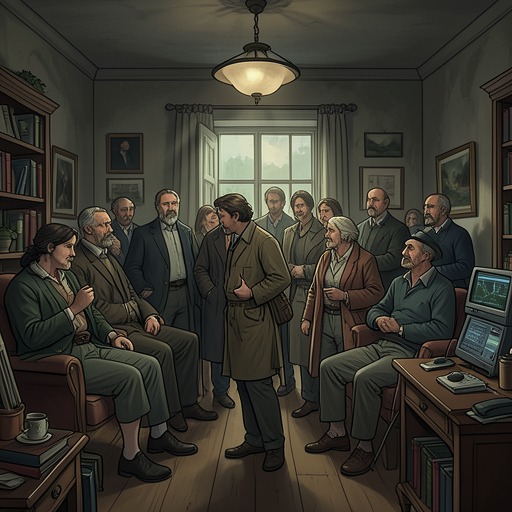
The house appears as a lived-in family space, not an abstract backdrop. On one late evening, Mrs Ramsay enters the nursery intending to keep quiet, only to find James awake, Cam sitting upright, and Mildred out of bed. The immediate problem is a horned skull fastened to the wall: Cam cannot sleep with it in the room, while James screams if anyone touches it. The episode places the house’s ordinary responsibilities—children, bedtime, and care—alongside an object that has unsettled the room. Its atmosphere is made through such intimate domestic circumstances, with family life depending on who is present and what is left in each room.
The familiarity of the house also becomes a source of continuity. Its rooms and furnishings are associated with the lives of the people who have inhabited it, and the house is imagined as a place to which those lives might return in memory. That continuity, however, does not make the building immune to absence. When the family no longer occupies it, the same rooms that once held conversation and movement become vulnerable to neglect, and what remains of domestic life is increasingly material: furniture, clothes, books, and household objects.
Abandonment and the House’s Empty Rooms
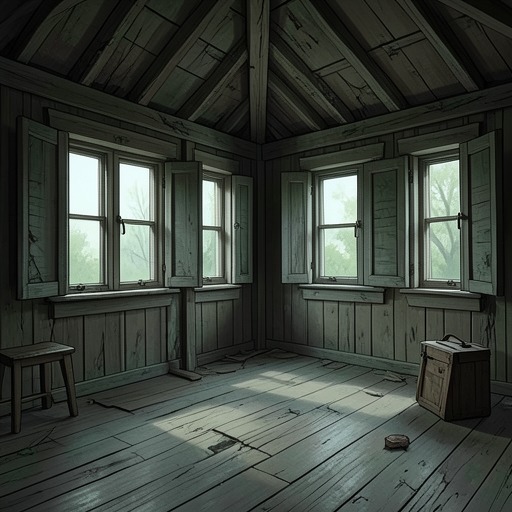
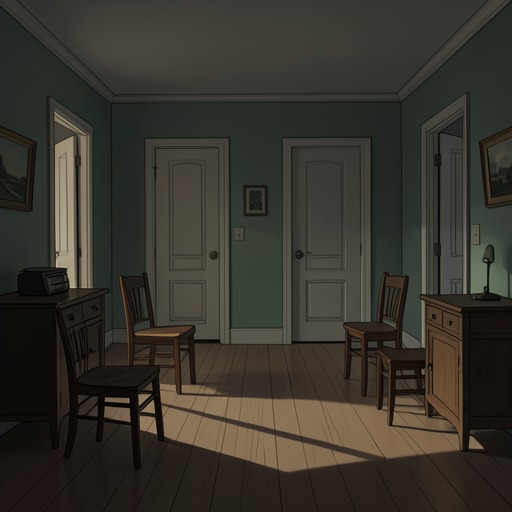
With the house empty and its doors locked, air moves through rooms where nothing wholly resists it. Hangings flap; wood creaks; tables, saucepans, and china are left exposed to deterioration. A pair of shoes, a shooting cap, and faded clothes in wardrobes retain the suggestion of people who have gone. The narrative lingers on the traces of use: a looking-glass that once held a face, a door through which children once rushed, and objects that remain after the hands that used them have disappeared. The house’s emptiness is not simply a lack of occupants; it is a visible contrast between past animation and present stillness.
As the building declines, the changing light continues to cross its rooms. The shadows of trees move over a wall, and birds pass across the floor, while the house itself remains unoccupied. Loveliness and stillness persist, but they belong to a structure from which life has departed. The contrast makes the building seem to possess a quiet existence of its own, even as its human meanings become harder to sustain. Weather and time press upon it without answering the question of whether anything human can endure.
The war enters this quiet setting indirectly, through damage, absence, and information rather than through a sustained scene of battle. Hammers sound in the neglected house, and their shocks loosen the shawl and crack teacups. The sounds are then connected to the news that a shell has killed Andrew Ramsay in France, along with other young men. The juxtaposition makes distant violence legible within a domestic space: the house’s breakage and the family’s loss occupy different scales, but the narration places them within the same altered world.
The wider landscape also challenges any comforting belief that natural beauty supplies an answer to human suffering. Those walking by the sea encounter signs that sit uneasily beside its ordinary beauty, including a ship that appears and vanishes and a purplish mark on the water. The possibility of finding consolation in the landscape falters: Nature is presented as indifferent to human misery and torture. For the house, this indifference sharpens the force of abandonment. Its preservation is not guaranteed by the beauty of its setting; it depends on human care.
Decay, Memory, and the Work of Repair
Mrs McNab’s recollection makes the abandoned house a storehouse of personal memory. Among the clothes left in its bedrooms are Mrs Ramsay’s things, including an old grey gardening cloak. Mrs McNab remembers seeing Mrs Ramsay in it, sometimes with one of the children beside her. Boots, shoes, a brush, a comb, handkerchiefs, and ribbons remain in place, making return seem imaginable even though Mrs Ramsay has died. The objects do not restore her, but they give memory particular things to hold on to.
That personal history exists beside the practical burden of neglect. Mrs McNab finds mouldy books and belongings, fallen plaster in the hall, and a blocked rain-pipe over the study; the garden has run wild. She is old, her legs hurt, and the work exceeds what one person can manage. The family has been away for years, sending money but not visiting, and its clothes remain in the cupboards. Her account ties the house’s physical deterioration to the difficulty of maintaining a place when those who belong to it are absent and help is scarce.
The building reaches a point at which it might sink into ruin altogether. The imagined future is stark: the roof falls, plants cover the path and windows, and only a fragment such as a poker or piece of china might indicate that anyone had lived there. Against this prospect, Mrs McNab and Mrs Bast begin the exhausting work of cleaning. They mop and scour, retrieve household objects from neglect, and bring back into use a basin, a cupboard, the Waverley novels, a tea-set, a brass fender, and steel fire-irons. Their labour does not reverse time, but it interrupts the house’s decline and rescues its contents from oblivion.
Repair is collective and incomplete. George, Mrs Bast’s son, catches rats and cuts the grass, and builders are brought in; inside, the women work upstairs and in the cellars. Their efforts produce concrete improvements, including a notable victory over the taps and bath, while the long rows of damaged books remain a more difficult, only partial task. The work is painful and ordinary, undertaken with brooms, pails, and repeated exertion rather than ceremonial purpose. The house is saved not by a single dramatic restoration but by accumulated labour that makes some rooms and possessions usable again.
Return and Continuing Absence
A message from one of the young women changes the course of the repair work: the house must be made ready, as the family may come for the summer. After the long interval of neglect, the prospect of return gives the cleaning urgency. In September, Lily Briscoe arrives at the house late one evening, and Mr Carmichael comes by the same train. Their arrival marks the house’s return to human use, though the gathering is not a restoration of the former family. Mrs Beckwith is also staying there, and the house is full again in a new arrangement of people.
The return does not erase the losses that have accumulated. On a morning there, Lily feels detached from the place and struggles to connect its present-day occurrences into a coherent whole. She repeats to herself that Mrs Ramsay is dead, Andrew has been killed, and Prue is dead too, but the facts do not immediately awaken feeling. The house can again contain people and conversation, yet the deaths remain difficult to absorb. Its apparent recovery therefore holds together renewed occupancy and continuing bereavement rather than resolving one into the other.
The summer house’s arc gives physical form to the novel’s concern with the persistence and limits of memory. The empty rooms preserve signs of former lives, but preservation alone cannot make those lives return; cleaning can rescue a tea-set or a book, but it cannot undo death or restore a household exactly as it was. The movement from family occupation to abandonment and back to partial use makes the house a record of time’s pressure and of the human effort required to keep a place, and its histories, from disappearing altogether.